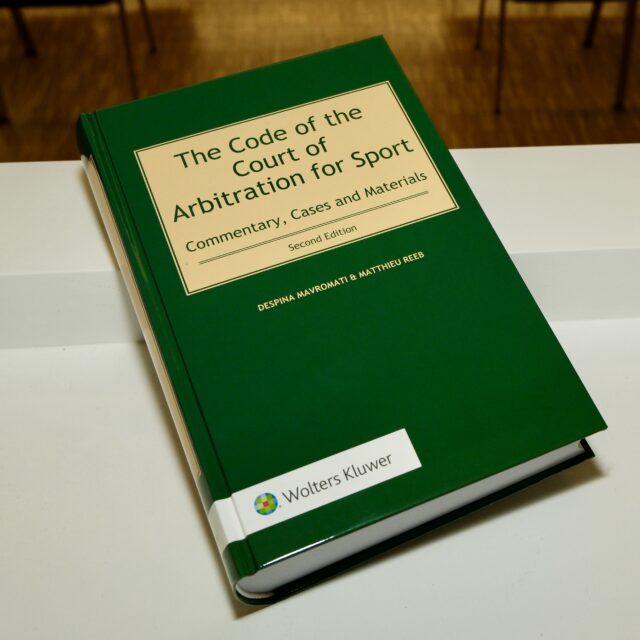


Swiss Federal Supreme Court (SFT) Judgment 4A_420/2022 of March 30, 2023,
Cardiff City FC v. SASP FC de Nantes
Motion to set aside the CAS Award CAS 2019/A/6594 of August 26, 2022
This case relates to the internaDonal transfer of the ArgenDnean football player Emiliano Sala
to FC Cardiff (“Appellant”) from FC Nantes (“Respondent”, jointly referred to as the “Par5es”)
in January 2019 and his tragic plane crash which occurred shortly aQerwards. The SFT
judgment essenDally relates to the scope of the arbitraDon clause between the parDes to a
transfer agreement but also to the interpretaDon of the scope of disputes that can be decided
by the FIFA dispute resoluDon bodies and, subsequently, by the CAS.
The ParDes had agreed on a transfer price of EUR 17,000,000, to be paid in three installments,
with the first installment of EUR 6,000,000 payable within five days aQer the registraDon of
the player with FC Nantes. Hours aQer the finalizaDon of the transfer agreement with the FIFA
Transfer Matching System (“TMS”), the player tragically died in a plane crash over the English
Channel.
FC Nantes filed a claim before the FIFA Players Status Chamber (“PSC”) requesDng payment of
the first instalment, but FC Cardiff argued that FC Nantes was liable for the circumstances that
led to the player’s death, thusit intended to claim set-off for damages against the claims raised
by FC Nantes. The FIFA PSC upheld FC Nantes’ claim and held that it had no jurisdicDon to hear
the claim for damages.
FC Cardiff appealed against the FIFA PSC decision to the CAS which dismissed the appeal. The
CAS panel bifurcated the procedure and decided, as preliminary ma_ers, the validity of the
transfer contract, the PSC and CAS had jurisdicDon to hear the claim for damages, and the
possibility to exDnguish a contractual claim by a set-off tort claim. AQer declaring that the
transfer had already taken place before the player’s accident, the panel held that neither the
FIFA PSC nor the CAS had jurisdicDon to rule on a claim of extra-contractual nature (i.e., the
claim that FC Nantes was responsible for the player’s death).
In the subsequent appeal to the SFT, the Appellant invoked a violation of Art. 190 (2) (b) of the
Federal Act on Private InternaDonal Law (“PILA”) considering that the CAS panel had
erroneously interpreted the arbitraDon agreement enshrined both in the contract and in the
FIFA regulaDons. In a very interesDng analysis, the SFT reiterated the various principles of
statutory interpretaDon applying to the regulaDons of large sports federaDons, such as FIFA.
This note discusses the key findings in the SFT judgement.

Interpretation of the contractual agreement by the CAS and the SFT
The SFT confirmed the CAS panel’s view that its own jurisdicion could not go beyond the
jurisdiction of the FIFA PSC. Even though Art. 377 para. 1 Swiss Code of Civil Procedure (“CPC”)
provides for the right of the panel to deal with a counterclaim for damages, there were no
reasons that justified the concurrent ruling on claims based on the transfer agreement and on
(the unrelated) set-off against a tort claim (at 5.3). Notwithstanding the broad formulation of
the arbitration agreement in the transfer contract (“Any dispute arising out of or in connec:on
with this transfer agreement…”), the contract did not extend to the clearly distinct set-off
claim for damages based on the plane crash (at 5.4.3).
Interpretation of the FIFA Regulations
Refraining from rendering a general judgment, and while acknowledging that it is in principle
possible to invoke a claim for a set-off in international arbitration for indirectly related claims
(cf. 4A_482/2010), the SFT then dismissed the Appellant’s arguments on the interpretation of
the arbitration agreement based on the FIFA Regulations. In fact, and even though the latter
reserve the possibility to file a counterclaim (asserting a set-off claim), the FIFA dispute
resolution bodies are not “true” arbitral tribunals and, as such, they are not bound by the
arbitration provisions enshrined in the Swiss Code on Civil Procedure (at 5.5.4).
Accordingly, the jurisdiction of the CAS panel in appeal could not be broader than that of the
association’s tribunal that had first ruled on the ma_er (in this case, the FIFA PSC). After
analyzing the pertinent FIFA regulations, the CAS – and the SFT – confirmed that the possibility
to file a counterclaim before the FIFA PSC could not bind the latter to rule on any claim for
damages raised in this context (at 5.5.5).
Employing various instruments of statutory interpretation, the SFT further confirmed the
limited material scope of the FIFA PSC jurisdiction, which does not extend to ruling on civil
disputes of football stakeholders that are unrelated to football. The limits for the
rendering of the FIFA decisions along with a cap on the procedural costs were also considered
in order to conclude that FIFA did not intend to include the hearing of complex and unrelated
set-off claims by its dispute resoluDon bodies and, subsequently, by the CAS (at 5.5.5.4).
Other grievances: violation of the parties’ right to be heard and of material public
policy
FC Cardiff further raised the issue of a violaDon by the CAS panel of the principle of equality
of the parties for refusing to adjourn the hearing of its expert witness. Such plea was swiftly
dismissed by the SFT to the extent that the panel had included the expert report in the file
and that such report was found to have no influence on the outcome of the proceedings. The
SFT equally dismissed all other pleas on violation of the Appellant’s right to be heard, holding
that the panel had rejected – at least implicitly – the various arguments raised by the
Appellant (at 7).
Finally, the SFT thoroughly dismissed the Appellant’s claim for violation of public policy
alleging the Panel’s refusal “to examine (or even inves:gate) acts of corruption” (at 8.2.2).
After reiterating the very restrictive scope of substantive public policy, the SFT held that such
violation could only be admitted if the corruption had been established but the Panel stll
refused to take it into account, which was clearly not the case (judgment 4A_532/2014 of
January 29, 2015, at 5.1).
Conclusion
Overall, this is an interesting and thorough judgment rendered by the SFT that highlights the
specificities of sports arbitration with respect to the scope of the arbitration agreement but
also delves into the jurisdictional scope of the FIFA decision-making bodies, which draw the
limits of the subsequent jurisdiction of the CAS.